WHEN YOU'RE HURTING
23. Nothing Really Matters (in the Long Run)
"It is not death that a man should fear, but he should fear never beginning to live." —Marcus Aurelius
Dear Kids,
I recently had one of those late-night conversations on the so-called "meaning and purpose of life" that all twenty-year-olds seek amidst their raging existential angst into the emptiness of space (perhaps I never grew out of it), and we reached the inevitable conclusion, perhaps only brought on by the wisdom that arrives at 2:00 a.m., that at the end of the day, nothing really matters. That's what I want to write to you about today — not failure being recoverable, which is its own letter, but failure and every win being eventually irrelevant. It sounds dark on the page. In practice, when you actually sit inside the thought, it flips into something that feels strangely like freedom.
I certainly don't mean to sound morbid and nihilistic, as in nothing really matters, there's no will to live. Actually, quite the opposite. All of the issues, arguments, and fears that we have, especially the ones we invent in our own heads — do not matter. One of my favorite Mark Twain lines: I've had a lot of worries in my life, most of which never happened. All the petty arguments with friends, the perceived insult from a coworker, the angry stare from a waiter because you only tipped 20% instead of the 35% expected in the French Riviera — they don't matter. But the opposite is also true. The sexy vacation photos, the Microsoft Dynamics Azure Suite AI Lean Sigma Black Belt Certifications on LinkedIn, the new Ferrari — none of these matter in the long run either, and neither does your life as a whole.
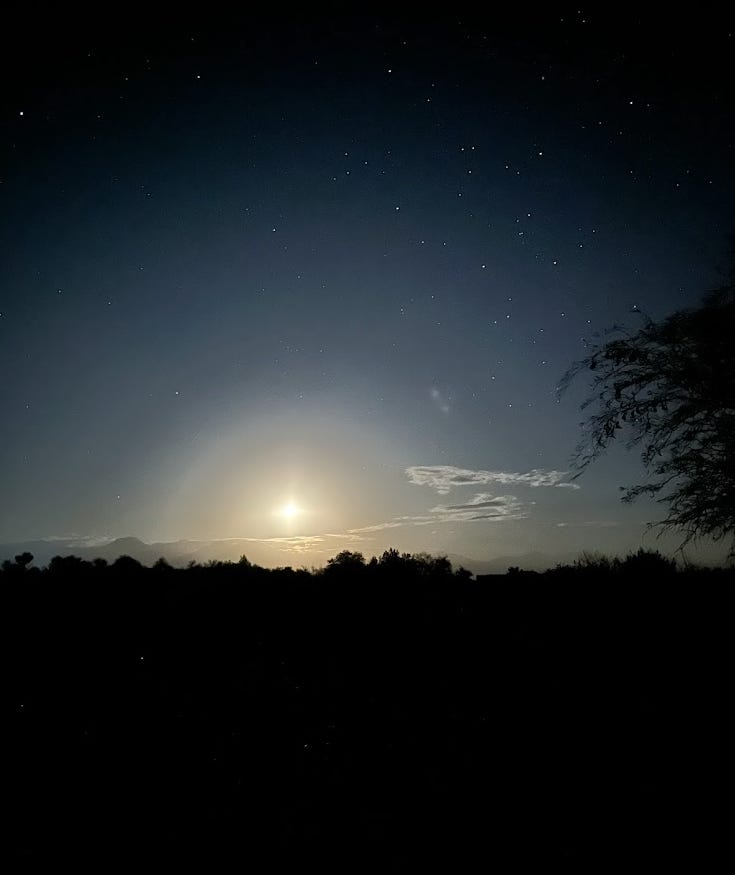
Look up at the stars
Perhaps the best way to contemplate this meaningless existence we have is simply to look up at the stars in the night sky.
I learned this most vividly in the Atacama Desert in Chile, one of the best places on earth to stargaze, where the air is so dry and the light pollution so minimal that the Milky Way reads like a printed sentence across the sky. The strange thing about Atacama is that you have to scramble to see the stars — because the moon rises so brightly there that within an hour the moonlight floods out everything else, and the universe goes back behind the curtain. So you stand there at three in the morning in a freezing high-altitude desert, racing the moon, and the whole arrangement makes you feel very small in exactly the right way. I will never forget standing under that sky. It rearranges you.
When you think about how many planets and galaxies are out there, billions of light-years away — the 13.8 billion years since the Big Bang banged out a bunch of energy, of which the years of our lives are insignificantly small; how the light you're seeing now was emitted millions of years ago by supernovas and stars way bigger than anything you can imagine, some of which have already internally collapsed into black holes that suck in more energy than government bureaucrats at the local DMV — and then you look down at your phone because the cute girl you have a crush on didn't text you back, and that's obviously the most important thing that has ever existed in the history of the universe…
Exhibit 1: perhaps one of the greatest tragedies in human existence. Although it's still better than if you'd sent a message by carrier pigeon in the 1300s and didn't know whether the reason you were being ghosted was because:
- She doesn't love you,
- Her family ate the pigeon,
- She died of bubonic plague,
- She met someone else at the club, or
- Her father married her off for 3 bushels of corn 🌽🌽🌽
Two ants fighting over a breadcrumb
Carl Sagan has put it way more eloquently than I can ever hope to — I'm in awe of how profoundly and simply he writes:
"Look again at that dot. That's here. That's home. That's us. On it everyone you love, everyone you know, everyone you ever heard of, every human being who ever was, lived out their lives... every saint and sinner in the history of our species lived there — on a mote of dust suspended in a sunbeam."
The quote strikes me as even more profound after a few years adjacent to the real estate business — for some reason, especially in Asia, there's the stereotypical land dispute that every family seems to suffer from, concerning some overgrown plot of grass that a grandparent inherited thirty years ago as part of military service on the winning side, which somehow got rezoned by the local government to residential land that surely will appreciate in value because of a new infrastructure project like an airport. Because of this glorified, flooded piece of dirt, siblings stop speaking with one another, lawsuits ensue, and families are torn apart.
If there is a God out there, he must be thoroughly entertained at our folly and naivety — much like the way we look at two ants fighting over a small breadcrumb because they thought it must be the most important thing to ever exist in ant history, when in the next moment it starts to rain and the ants are suddenly swept away to their deaths anyway… 🐜🐜
If nothing matters, then what do I do with my life?
I argue that precisely because nothing matters, we have the liberty and empowerment to do exactly what we seek to get out of life.
Frankl again — and you've already met him a few times in these letters — writes that ultimately, man should not ask what the meaning of his life is, but rather must recognize that it is he who is asked. Instead of asking what the purpose of one's life is, we should recognize that we are the ones being questioned by life. He believed that the meaning of life is discovered in the world, differs from person to person, and can change day by day. He believed that people can respond to life by being responsible — literally, "response" + "able."
The other thinker I keep coming back to on this same point is Albert Camus, who in The Myth of Sisyphus spends an entire book arguing that the universe doesn't owe us a reason and that we have to live anyway. Camus pictures Sisyphus condemned to push a boulder up a mountain for eternity, only for it to roll back down each time he reaches the top — and then, in the last line of the essay, he writes: one must imagine Sisyphus happy. It sounds like a punchline. It isn't. The whole point is that the absurdity of the task doesn't have to be a verdict on the man performing it. Sisyphus owns the boulder, the hill, and the descent back down — and that ownership, not the result, is the thing. I read Camus during a Beijing winter when the cosmic-insignificance argument was tilting me toward fatalism. He pulled me back. Meaning isn't pre-installed in the universe — and that's exactly why the meaning you build yourself counts as yours.
When I reflect back on my early career, I realize the fundamental problem was that I'd mortgaged the answer to that question — what does life want from you — to external parties: family, parents, society, Taylor Swift (jk). Even when I knew the answers weren't really mine, I kept signing them. Why? Because I didn't yet have a strong understanding of who I was. And if you don't have a strong core belief in who you are, other people will decide for you, regardless of whether you like it or not.
The inverse is also true: if you let societal influences stop you from authentically pursuing the things that excite you and light your eyes up, you'll always be living within the constraints of dogma — other people's thinking. Steve Jobs said it cleanly: your time is limited, so don't waste it living someone else's life. Don't be trapped by dogma — which is living with the results of other people's thinking. The sad thing is you'll never be at your best in that state, because you're trying to replicate someone else and be measured against their standards. The only way to win is to escape competition through authenticity. The only way to truly win is to realize that no one can compete with you on being you.
So what do I actually do?
As any good management consultant would ask: what are the action items? Like a similarly framework-driven, slide-toting consultant, I'll offer three.
First, know yourself. "What do you mean, know myself? Of course I know myself!" — that's exactly what I thought when I was 15 and so sure of the world, and again at 20 when I realized how naive I'd been at 15, and again at 25 when I realized how naive I'd been at 20, and… you see where this is going. We're so dynamic and multifaceted that it may be impossible to fully know yourself at any single stage of life, because you're shaped by every new experience and relationship. This is actually a good thing — being a static person is not a goal worth striving for; it just means you've stopped growing.
But even if you don't change much at your current stage, knowing yourself is like peeling back the layers of the same onion to reach a deeper understanding. Watching Disney movies as an adult versus as a kid is the metaphor people use — the underlying depths of meaning and human complexity that suddenly become poignantly real, even though the movie script didn't change. (Same goes, I'm told, for doing Ayahuasca in the Amazon rainforest and realizing your childhood memories take on a new perspective when viewed through your parents' eyes — but that's a story for another day.)
Second, have the courage to pursue what life asks of you. This is where the philosophy of "nothing really matters" actually becomes useful, not depressing. You're going to die soon — maybe in 100 years, maybe in 5. So live a life that's authentic to you. Think about your decisions from the perspective of your 80-year-old self on the deathbed: are there things you'll regret never having the courage to do? The negative people who will criticize you along the way — don't worry about them. They'll also be dead soon. Have self-confidence, but don't be arrogant. Hold strong opinions, weakly. And ask yourself, often, whether you're doing something authentically for its own sake, or whether you've signed up for some version of the Deferred Life Plan — if I can have a billion dollars and a private jet, then I can do ABC. Do I truly believe in what I'm doing right now, or is this the outside world telling me I should be spending 100-hour weeks building DCF models at Goldman?
There's no universally right path. There is only what's right for you, at this place, at this time.
We were promised models in investment banking, but we forgot to specify what kind 🤦🤦
Third, avoid distractions — anything that pulls you off your path. Some distractions are obvious: social media, alcohol, things that vaporize your free time. Some are more pernicious: the lucrative job offer in a field that doesn't fit, the slow creep of your living standards into a lifestyle that traps you in financial obligations, or — most deadly — the small moral compromise you tell yourself is just a one-time thing.
Pascal said that all of man's problems come from his inability to sit alone in a room. We crave distractions and, in their pursuit, sacrifice long-term objectives for short-term pleasure — see the Stanford marshmallow experiment. Learning to discipline yourself and your emotions is one of the most underrated skills in surviving this modern world. It's why so many of the people I admire most have a meditation or journaling practice — these are tools to control the monkey mind.
I'll leave with Seneca, who would probably be entirely shook at modern society: what's the use, after all, of mastering a horse and controlling him with the reins at full gallop if you're carried away yourself by totally unbridled emotions? What's the use of overcoming opponent after opponent in the wrestling or boxing rings if you can be overcome by your temper?
The counterargument
I owe you the honest counterargument here, because cosmic-insignificance writing can become its own kind of cope. The voice in your head will say: if nothing really matters, then why try at all? Why be kind to anyone? Why finish anything?
The answer, I think, is that the insignificance is supposed to liberate you, not paralyze you. The point isn't that meaning doesn't exist — it's that meaning isn't pre-installed. Nobody else gets to assign it. Sagan's pale blue dot doesn't tell you to stop loving the people on it. If anything, it tells you that the people on the dot are the entire point, because they're all you've got, and the dot is all there is. The freedom is in choosing what matters, knowing full well that the universe doesn't owe you a reason.
So remember, kiddos, to sometimes, at night, put your technology away and look up at the stars. Appreciate this life, this moment, this place, with the people around you now — because at the end of the day, nothing really matters.
And precisely because of that, everything you choose to do anyway is yours.
Love,
Dad.
Postscript