WHEN YOU'RE OLDER
28. Youth Is Wasted Upon the Young
"Modernity: we created youth without heroism, age without wisdom, and life without grandeur." —Nassim Nicholas Taleb
Kiddos, there's one hard part of getting older that I saved for here, because it hides in plain sight. It isn't a crisis. It isn't a heartbreak. It's the quiet, daily theft of time itself.
George Bernard Shaw once wrote that "youth is the most precious thing in life; it is too bad it has to be wasted on young folks." When I first read that line I thought it was the smug muttering of an old man, the kind of patronizing observation that older generations always make about younger ones. Then, recently, I found a few gray hairs in the mirror, and I started to suspect Mr. Shaw might have been writing from somewhere more honest than I'd given him credit for.
Growing older is a strange feeling. The changes day to day are imperceptible. Each new morning is more or less the same as the last. And then, one afternoon, you stumble across a photo of yourself from six months ago — or, worse, six years ago — and the entire passage of time hits you in the chest at once. You don't quite recognize the person in the photo. He looks like you, but lighter, somehow. Less weathered.
Or, perhaps, you'll relate to my own version of this. As I approach thirty, an invitation to "go out" with friends on a Friday must now satisfy the following necessary but not even sufficient conditions:
- There must be non-alcoholic options, with limited sugar (ideally non-processed, organic kombucha, or hot tea without caffeine).
- The music must be low enough to have a conversation without shouting.
- There must be no extremely bright lights, ideally no blue light, as that would disrupt my melatonin production and sleep cycles.
- There must be no overly intoxicated people, and — worse — no overly negative, gossipy, or pessimistic ones.
- The plan must not disrupt my pickleball schedule.
- The location must be within a reasonable radius of my apartment.
- I must be able to slip out before 11 p.m. in time for my evening reading routine.
Compare this with my twenty-two-year-old self, whose sufficient condition was an elegant, last-minute three-word text: "Bro, let's go." The modern-day Shakespearean stanza that once incited my heart to action.
Your body is on a one-way road
There's something genuinely special about being young, and I don't mean that in a wistful way — I mean it in a structural way that I want you to actually internalize while you still have it.
Talk to any older person and they'll eventually start reminiscing about physical feats of strength and flexibility from their younger years. Look at the old black-and-white photos of your grandmother — really look. Notice that she was once beautiful, before the wrinkles that life etched into her brow. She too once broke hearts. She was chased by boys. She flirted, got drunk, made questionable decisions — not necessarily in that order.
I'm going to be honest with you in a way that might sound harsh: your physical appearance and capability are on a one-way road from roughly your early twenties on. You will never be fitter, more attractive, or more flexible than you were a few years ago. In fact, you're a little less of those things now than you were before you started reading this sentence. People will tell you that you can always work on yourself, and that's true — but past a certain point, all of that work is just optimizing a local maximum on a downward curve.
The book that drove this home for me, more than any of the philosophy I've read, was When Breath Becomes Air. Paul Kalanithi was a neurosurgeon in his mid-thirties when he was diagnosed with terminal lung cancer, and the memoir he wrote in his last months is the most honest account I've come across of what it means to suddenly see the bottom of your own clock. I read it in a single sitting in a hospital waiting room while my grandmother was in surgery, the kind of place that strips the abstract away from any book about mortality, and the line that stayed with me — paraphrased, because I lent the book away and never got it back — was something like: the tragedy isn't only the years you don't get, it's the years you had and spent on things that didn't matter. Kalanithi wasn't writing about indulgence. He was writing about the slow, respectable waste of attention on prestige, performance, the next promotion. The young squander their bodies on parties; the slightly less young squander them on a calendar. He noticed it from the other side. I'm trying to notice it from this one.
This is not a reason to despair. It's a reason to use the body while it still does what you ask of it. Take the scuba trip. Take the kitesurfing lesson. Dance. Stretch. Aspire, half-seriously, to look like a Greek god or goddess. Travel hard — I've never understood the people who defer the dream trip until retirement, by which point they're tired and sickly and can't actually enjoy where they've ended up. Climb the mountain now. Sign up for the marathon, the 10k, the Ironman, the Spartan race. Play pickleball. Run.
All of these things will only get harder. None of them will get easier.
The innocence we lose
But this letter isn't just about the body. It's about the other thing we lose, which I think is worse, and which we almost never talk about.
When we're young, we approach life without expectations. We're unjaded. We meet every event as if for the first time, without force-fitting it into some pattern we've seen before. We don't yet have the catalog of disappointments that older people carry around — the catalog that quietly tells you, before every new encounter, what to expect.
When we're young, we believe in fairy tales. We believe love can endure. We believe people don't usually try to hurt us on purpose. We believe our parents are perfect, instead of seeing them as flawed humans carrying their own griefs. We believe in Disney endings. Good defeats Evil. The rainbow comes after the storm. A butterfly landing on a flower is enough to stop us in our tracks.
We don't filter our words. We don't censor our emotions to fit social propriety. We just say the thing. We chase what makes us happy without first running it through the calculation of how it'll be perceived.
Youth lets us approach relationships with a kind of innocence that becomes almost impossible later. No ulterior motives. No "networking opportunity." No quiet, half-conscious calibration of whether this person is worth our time. We assumed anyone could be a friend, regardless of how they looked, how many followers they had, or what their parents did. Every interaction, and every person, was sufficient as it was.
Somewhere along the way, that goes. The catalog of past disappointments thickens. The filters come on. The self-censorship begins. And the strangest thing is that we don't notice it happening — we just wake up one day older, more "mature," and notice that we no longer feel things quite as cleanly as we used to.
If you read about the symptoms of schizophrenia — the voices, the delusions, the inner narratives that won't stop — and then conduct an honest examination of your own adult mind, you may notice an odd familiarity. The doubt before the important opportunity. The self-censorship before the honest sentence. The fear of looking foolish that quietly shuts down half of what you might have said. Aren't those also delusions arising inside your head? Don't they also begin in young adulthood, when you're more susceptible to being shaped by society?
This is the part most adults won't admit. The vices people turn to — alcohol, drugs, trashy television, the doomscroll — are often attempts to mute that constant inner narration, the catalog, the filters. The healthier versions — art, writing, poetry, music, sport — are attempts to do the same thing through flow rather than escape. In both cases, we are quietly trying to recover the mental state that we had at ten, when we hadn't yet learned to be afraid of ourselves.
Youth is a choice you make
Here's what I find hopeful, though. We celebrate, almost universally, the people who manage to keep their youth even as their bodies age. The grandparents who still tell dirty jokes. The seventy-year-old aunt who's back on the dating apps and probably has more game than you do. The aunties who finish marathons in their retirement years. The late bloomers — Toni Morrison published her first novel at forty. Samuel L. Jackson's breakout role was at forty-three. Sam Walton founded Walmart at forty-four. Vera Wang started in fashion at forty.
If those people can stay young at sixty, why can't you stay young at thirty?
There's a Confucius line I keep coming back to:
"We have two lives, and the second begins when we realize we only have one."
The secret behind every late bloomer I've met is that they finally figured out, after years of toil, that they only get one life — and they decided to spend it as themselves. They stopped pretending. They stopped worrying about what they were "supposed" to be doing in their thirties. They stopped letting the catalog of past disappointments stop them from trying something new. They got younger as they got older, by the only metric that actually matters.
There's a line attributed to Benjamin Franklin that I think about a lot:
"Some people die at age 25 and aren't buried until they are 75."
I want you to read that and feel both the weight and the freedom of it. The years on this planet will march forward whether you participate or not. But whether you actually live them is, more than anyone wants to admit, a choice you make and re-make every day.
So when the catalog tells you "don't bother, you've seen this before," try to remember: you haven't. Not really. Not this exact moment, with this exact person, with this exact version of yourself. The first time is still available. You just have to stop pretending it isn't.
What will you choose?
That's really the question this whole letter is asking. The body fades. The innocence fades. The catalog of past disappointments thickens. None of that is optional. What is optional is whether you let those things become the entire structure of your inner life, or whether you keep one door open — the door to wonder, to embarrassment, to risk, to enthusiasm without irony.
It's easy to look older than you are by closing that door. It's much harder, and much more rewarding, to keep it open.
So I'm telling you, while you're still young enough that this might feel like cheating: stay young on purpose. Be a little embarrassing. Sing loudly. Dance without checking who's watching. Talk to the stranger. Take the trip. Ask the question that might sound dumb. Cry at the movie. Laugh too hard at the joke. Sit with people who are decades older and notice how the ones who light up the room are the ones who never lost the thread to their younger self.
Postscript
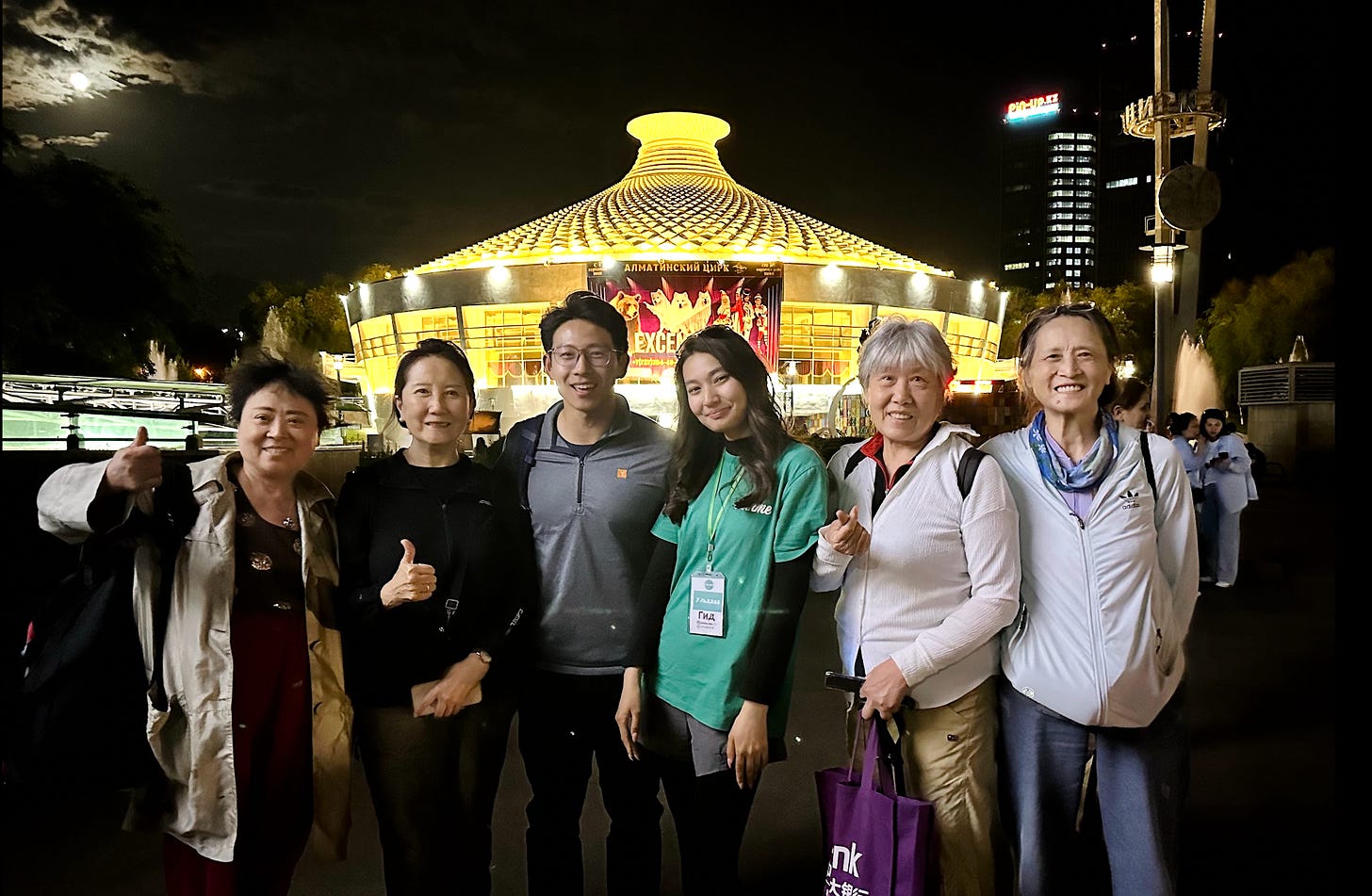
One of my favorite trips last year was through Kazakhstan, where I ended up on a bus tour with four Chinese aunties around my grandmother's age — best friends from way back, doing a spontaneous trip across Central Asia together. They didn't speak Russian or Kazakh, so I got the unexpected privilege of translating for them.
At every stop they piled off the bus and immediately started taking what I can only describe as a never-ending stream of WeChat-ready photos. They filmed TikToks. They hit on the young, handsome local guides. They rode horses. They ate everything that was put in front of them. They drank. They rowed boats. They sang and danced and laughed for what felt like the entire trip.
I swear to you, kiddos, they had more energy than most twenty-year-olds I know.
Isn't that — instead of sitting alone on a luxury resort getting steadily more drunk on your seventh piña colada — what we should all be aiming for?
Chinese aunties rocking out to Kazakh pop in a borrowed bus, in a country none of them had ever been to. What a vibe. That's the version of growing old I want for myself, and for you.
Love,
Dad.